|
This was to be the final move of the 353rd Infantry. In the preceding changes of position there was some possibility of return; at any rate, another move would be sure to follow. But when the regiment left the area of occupation in Germany, demobilization was to follow and service ended not merely in the Army of Occupation but in the Army of the United States. So this move involved not merely a change of position but a return to civilian life. 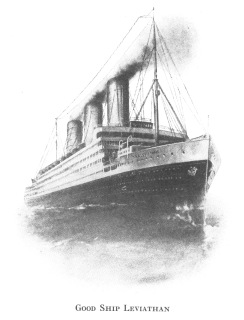 Even a change of position means a busy time but never before had the officers and enlisted men of the 353rd Infantry experienced such a rush as during the final days in the Army of Occupation. The regiment must be ready on schedule time, and woe to the man who would look back once the movement was begun. Ready to move meant that the men were personally inspected, thoroughly equipped and properly recorded; that all surplus property had been turned in; that the billets had been set in order and the towns policed; that all accounts had been closed; that provision had been made for the trip. All these things must be done to the satisfaction of G. H. Q. inspectors. These gentlemen must approve the past and present and place their guarantee upon provisions for the future. Any slip-up might cause the division to lose out on the sailing date, so each man accepted full responsibility for his bunkie and all agreed to see that the 353rd Infantry was ready to move on time.
The medical detachment had waged unceasing warfare against the cootie for many weeks and so far as humanly possible to determine they had succeeded, but the inspectors appeared with magnifying glasses. By the aid of these instruments a few were still found. The discovery resulted in the transferral of some valuable medical officers at the last moment and a renewed attack on the cooties until not one could be found, even with double E field glasses. Personal inspection went on to hair-cuts. One inch was the maximum length. Quite a few of the men had carefully clipped their locks to civilian proportions. They had hoped that only a civilian suit would be necessary to reinstate them completely in civilian life, but according to this regulation they would have to outgrow a military hair-cut. No one cared to take any chances at the port of embarkation over such a trivial thing as a hair-cut, so they reluctantly went back to the barber for a "hair-cut" instead of a "trim." The final inspection and the one upon whose findings depended the passport for each individual was the venereal inspection. A man might be deloused or have his hair cut at the last moment, but if he was found to be venereally infected, he must bid his comrades farewell and remain on foreign soil. No less searching was the investigation of equipment. Orders called for, "An actual physical check by officers under the supervision of divisional inspectors of each article of clothing and equipment in the possession of every man of the enlisted personnel." Shortage lists were compiled so that equipment might be completed at the port of embarkation. The painful part about this check on equipment came in connection with souvenirs. Orders had appeared repeatedly since the days of the St. Mihiel offensive demanding signed statements that all enemy property had been turned in. But some of the men still retained precious keepsakes of the campaigns--a Luger, a pair of field glasses or perhaps a sword. They had carried these on the long march and hoped to show them as they told their story to the home folks. Reports had come back of "show down" inspections at the dock. It was enough to endure the hardship of war and at this late date no one cared to take chances on a court martial, so souvenirs went with the surplus. These matters concerned the men as individuals; there were requirements equally exacting for the organization as a whole. On April 23, Lieut. H. F. (Light) Browne issued the following memorandum to supply sergeants:
The special precaution about tying shoes together is slightly indicative of the value set on time during these days. Animals must be turned in at Trier and Wengeroth on May 1st and 2nd. This increased the problem of collecting material and distributing rations but the Supply Company of the 353rd Infantry was on hand at the appointed hour. With the surplus property out of the way, policing billets and towns became a simple matter. The men carefully rolled their packs so as to make sure of their possessions and carried them to the street. When they returned they had nothing to do but "make a cleanin' " and they did it with a vengeance. Another skirmish through the streets completed the police to the satisfaction of the inspectors. It remained now to square accounts with the civilian population. Proclamations had been posted notifying them to turn in all claims for damage. Officers were required to pay for messes and kitchen. Final settlements were largely in the hands of the town majors. These town majors must have clearance receipts from the burgermeister within their area. All claims must be settled before leaving the posts. When the train pulled in every man, town majors and all, were waiting to go aboard. The first trains were made up of forty cars (hommes-chevaux type), one coach for officers together with two of the former type, sleeping cars for officers, one kitchen car and two baggage cars. Each train carried approximately nine hundred men and fifty officers. The first train left on the evening of May 6th; the second followed early in the morning of May 7th, and the last train with Regimental Headquarters, Headquarters Company, Companies "A" and "B" and some artillery troops at 8:07 p. m. May 7th. 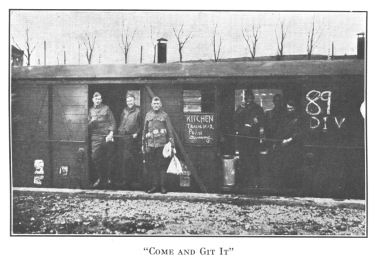 Everybody was glad to go and good feelings spread to those who were left behind. Mother Fitzgerald and Miss Heermance had gone to Brest several days earlier to arrange for a "Y." Miss McCrossen and Miss Roth, Red Cross workers, and the nurses from the evacuation hospital distributed handkerchiefs, toilet bags, and doughnuts by the ambulance load. During the occupation period the personnel of the evacuation hospital and the personnel of the 353rd Infantry had become fast friends. For a time there was some misunderstanding about the regulations forbidding nurses to associate with enlisted men, but this came to be understood as other army regulations for which those immediately concerned were not responsible and mutual appreciation grew with acquaintance. Even the civilian population was on hand, though they were prevented from expressing their good wishes they looked them at a distance. The Americans had taken their beds, they had forced them to sweep streets; they had made them pay respect to the national hymn; but experience had taught them confidence in the American sense of justice and good will. Enemies as well as friends waved good-bye until the train rounded the hill. Train orders were rigid. A non-commissioned officer was in charge of each car and sentinels were detailed to maintain order. The Troop Movement Officer reported: "Two men have each lost a leg, one man his life and the Paris Express has been derailed through failure to comply with orders." Officers as well as enlisted men were determined that no accident should occur on this final trip to the port of embarkation. Car doors toward the opposite track were kept closed. Men left and returned to the cars at the bugler's call. Each train of the 353rd Infantry came into Brest without a casualty. Information was vague as to the route and schedule but the various station masters had orders along the way and kept the train moving which was enough to satisfy the men. Chaplain O'Niell, who had already become famous for his ability in "making arrangements" for supplies with various auxiliary organizations, had lined up a double portion of doughnuts at Trier. It was a rough and tumble ride to Conflans where breakfast was served the next morning. But the outfit was on the road home and any sort of goin' " was good. Spring was in full sway throughout the rest of the journey. Trees were in bloom and peasants were working their fields. The route led through Etain to Verdun--practically the line of German advance into France. The train halted on the heights at the outskirts of the city for dinner. The loose chalky hill side mingled with rock and cut through trenches seemed to indicate the work of an internal upheaval rather than the destruction of artillery from the surface. Here and there a wretched stubby tree with only an occasional branch told the violence of shell splinters that lay everywhere. Down within the city one group of German prisoners was clearing away wreckage and another was shaping up the graves in a French cemetery. Men and nature combined to restore the devastation of war. 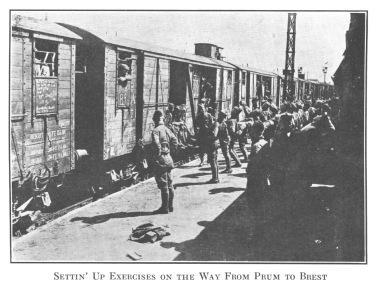 When the train pulled on through and crossed the Meuse, the men looked back at the defenses of the irreducible salient. Hills to the front and on either flank protected the low plain to the rear. Everywhere within this area were openings to underground shelters and along the way were still the signs of shelling that had all but cut off the approaches to the city. It was clear that the real defenses of Verdun were not hills and forts but the unconquerable men who had said, "They shall not pass." 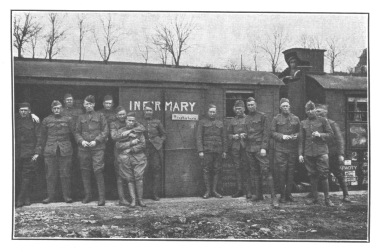 The route continued down the Meuse through wire entanglements and strips of No Man's Land to St. Mihiel. Barges were rotting in the sluggish canal that paralleled the railroad. Both railroad and canal had been cut by the Germans from the earliest days of the war untit the reduction of the St. Mihiel salient on September 12, 1918. St. Mihiel was peculiarly interesting to the men of the 353rd Infantry, for the name itself reminded them of their first time over the top. Life seemed to be ebbing back into the ruined city. Some homes showed signs of recent repair and one could scent the fresh dug soil of gardens. But the creak of the train and the resounding voices of the soldiers in the stillness of the evening still brought feelings of desolation. It was still light when the train pulled into Commercy. Battlefields were passed. Here all was activity and industry. Seven months before the 353rd Infantry had moved through this city for a part in the Meuse-Argonne offensive. The men talked over the wild night ride from Jouy to Recicourt and the experiences that followed. Always they reached the same conclusion: "The greatest exper- ience of a life, I wouldn't have missed it for a million but I wouldn't go through it again for a billion." Steadily the train rolled on through Florentine, Auxerre, Cosnes, and Bourges toward Brest. The country here showed few signs of war. Many fields were already planted and others were being cultivated. Surely France would soon recover from the war. And then came the reality--worse than ruined fields was the loss of the nation's man-power. Everywhere women held the plow or drove the team. But the scenes before them suggested more to the Americans than the mere possibilities of economic restoration. They forgot fields and harvest, towns and industries in their sympathy for those who remembered loved ones, "Morts pour la France." They, too, were leaving comrades behind and must try to carry a message of consolation to neighbors back home. The next stop was Gievres, the baggage depot of the A. E. F. Cities were now coming to be of interest because of the part they played in American activities. At St. Aignan was the last of the great replacement camps. Here were the insignia of all divisions. Civilian tradesmen crowded along the train at every stop. They had come to take advantage of soldier's appetite and American's generosity. Oranges sold seven for five francs, but the doughboy must have the oranges even though he felt that he was being held up by his ally. As the train rulled into Brittany, peasants lined the trains and called out "cegarette," "choclat." Whether they received gifts or a dash of water they answered "Mercie" and waved farewell. At about noon on May 11th the last train reached Brest and the entire regiment was again assembled at Camp Pontanezen, about five kilometers out of the city. Ships were already in the harbor, so without delay preparations began for embarkation. Camp Pontanezen appealed strongly to the men of the 353rd Infantry. Activities here were on a big scale and distinctively American in spirit and function. Here were 1100 buildings and 6000 floored tents with a capacity of 20,000 permanent and 60,000 transient troops. Each soldier was provided with a bed and a mattress and as many blankets as he wanted. Twelve troop kitchens were in operation, each capable of feeding 8500 men in an hour. The bathing plant accommodated 2500 men per hour. From a small camp for 10,000 soldiers in December, 1917, it had grown under the stress of necessity to the largest camp in the world. Everything was done on a grand scale; battalions lined up for physical inspection and delousing. The men laid out, checked up, and rolled equipment "by the numbers"--ten minutes to the company. Records and company funds went through a similar schedule. Lieutenant Scanlon gathered up thousands of loose francs in the regiment and converted them into brand new American money. Almost before the men could realize what had happened in this big busy camp, orders came at noon on May 12th to go aboard the following morning. By noon of May 13th, the 2533 enlisted men and 135 officers of the 353rd Infantry were aboard U. S. S. Leviathan, the biggest ship afloat. They were the first troops aboard. Colonel Reeves was promptly appointed, and remained throughout the entire voyage, Troop Commander. Many things had to be done at once. Guard must be posted; mess must be arranged and police must be begun immediately. But officers and men were accustomed to dealing with new situations. Major Masseck was made ship's chief of staff; Capt. C. S. Turner, the ship's adjutant; Lieutenant-Colonel Peatross was placed in charge of the guard; Captain Dienst, police officer; Captain Keim, mess officer; Captain Eades took over the information bureau, and Lieutenant Underhill became the Army-Navy liaison officer. Each with his book of instructions began to "carry on." All went well until the "chow" line started. Through error or efforts for "seconds" it had gotten into an endless chain until a doughboy said to Captain Keim, "Will you tell me, sir, how to get out of this line? I have been around four times already and I can't go any more." In the evening of May 13th, the 356th Infantry came aboard. Troops of the 33rd Division and other organizations, together with casuals, followed, and at 8 p. m., May 14, 1919, the return voyage began with a grand total of 12,000 troops on board. The sea was quiet and everybody felt safe and content. Just a year before the 353rd Infantry had set sail from Hoboken. At that time hostile submarines were active along the American coast. The regiment was moving toward the western front for action. Now the ocean was clear of submarines and the men were looking forward to peaceful pursuits in the homeland. To the satisfaction of a task well done, were added all the comforts of life on this big ship, the Vaterland, that had been the pride of Imperial Germany. Moreover, it was with genuine pride and gratitude that officers and men read this final overseas order:
The voyage itself was uneventful. Except for guard duty, police, and abandon ship drill, the men had little to do but read and play games and think it all over. The presence of some 1400 wounded and disabled soldiers aboard reminded everyone, in spite of effort to forget, of the whole grim business in which he had been engaged. The sympathy of buddies went out to these men for whom the war would never end. And then, too, the joy of return was tempered by the thought of separation. Never before was it so apparent that these returning veterans who had left their homes as boys were now returning as men. The days went speedily by. Information from the naval authorities assured schedule progress. In accordance with instructions, reports had been submitted, "showing the number of officers and men destined for each camp or cantonment, destination given in each case to be the camp or camp unit nearest the place to which individuals are entitled to travel pay * * * * * * * * * These lists to be used as a basis of separation of the unit upon arrival in United States." It seemed probable, therefore, that the voyage would conclude the existence of the 353rd Infantry as a military unit. In anticipation of this event Colonel Reeves issued his final order aboard ship:
No returning soldiers ever received a finer welcome. Gaily decorated boats loaded with friends and relatives pulled up alongside. General Wood was there to greet his returning division. Bands and steam whistles helped to express the joy of the occasion. But almost to a man the doughboy gazed away, afraid to look into the eyes of his buddie lest he should reveal something of the emotion that filled his soul. |

