|
The enemy still had, according to the terms of the armistice, one day to clear out of the "invaded countries of Belgium, France, Alsace-Lorraine, and Luxemburg," when the 89th Division began its march to Germany. Advance elements of the Army of Occupation were close on the heels of the retreating forces.
So read Paragraph One of Field Order No.64, 89th Division. The word "pursuing" is marked out in the order submitted to the commanding officer of the 353rd Infantry, but it is too expressive of the spirit of the occasion to be omitted from history. The 89th Division, along with seven other picked American divisions, had been selected to form the Army of Occupation. With pride and confidence both officers and enlisted men entered upon this new duty. The terms of the armistice left nothing to be desired so far as immediate assurance of victory was concerned. They had overcome the enemy in battle, now they were to occupy his country. The situation was especially gratifying to the officers and enlisted men of the 353rd Infantry for their regiment was to form the advance guard of the 89th Division on the march. Briefly stated, the mission of the Army of Occupation was to insure compliance with the terms of the peace treaty. The doughboy was decidedly interested in the surrender of the German fleet, especially the submarines. He was keenly delighted with the statement of German equipment to be turned over--5,000 guns, 30,000 machine guns, 3,000 minennwerfers, 2,000 aeroplanes--the very thought startled him. Moreover, he realized that upon the accomplishment of a satisfactory peace treaty depended his return to the United States. But neither armistice nor peace treaty concerned the soldiers so immediately as the personal appeal of General Pershing contained in the following order:
This order was read at formations and came as a personal message to each man. American soldiers recognized in the new task the fulfillment of their mission in the American Expeditionary Forces and willingly "carried on." Every man understood at the outset that assignment to the Army of Occupation meant duty, not participation in a touring party. The conditions of the march itself were exceedingly difficult. Field Order No.64, 89th Division, contained this instruction:
In addition to complying with these stringent orders it must be remembered that each man carried equipment weighing approximately seventy pounds. Shortage of transportation added to the hardship of the march. Immediately preceding the assignment of the 89th Division to the Army of Occupation almost all the transportation facilities of the regiment had been turned over to divisions already on the march. When the Supply Company of the 353rd Infantry started to move on November 24th, there were scarcely animals enough to pull the kitchen and ration wagons, and only four Ford trucks were available for hauling surplus kits and baggage. In spite of unceasing effort the surplus kits and baggage had to be left behind after three days movement. But two weeks of recuperation in Stenay had put new life into the men, so after a final police they made the start on schedule time and in high spirits. It was hard to believe these were the same men who had dragged themselves into the city less than two weeks before. Every man now wore a complete uniform. Helmets fairly glistened with their new coats of oil and divisional insignia. The full packs, rolled and fashioned to the variation of a centimeter, seemed utterly out of proportion in comparison with the light packs carried in the field. But it was too early to feel their weight. One man, however, did remark at the moment of leaving, "Boys, we're no longer soldiers; we're government mules now." The First Battalion, commanded by Major Schutt, formed the advance party; the Second, commanded by Captain Adkins, was in support; the Third, commanded by Captain Postin, was already at Margny and maintained its station. Colonel Reeves rode at the head of the support and was in command of the advance guard. The route led oat of Stenay northeast over the national highway. Along the way were new scenes of depredation. The Germans had cut the fine trees on either side of the road, and, in preparation for a rear guard action, they had "dug in" behind the trunks. The question arose at once, "How could we ever have gotten up this road with Fritz still in those holes?" The answer came back, "Flank him." Down at the foot of the hill lay a pile of German helmets. Fritz had foreseen this reply several days earlier and had abandoned his helmets as well as his holes in his flight across the Rhine. Fields along the way were barren except for occasional bushes that had grown up during the many seasons since there had been any cultivation of the soil. The country appeared to be a continuation of "No Man's Land." Occasionally parties of refugees greeted the marching columns. Nearly all of them walked and carried their possessions on their shoulders or pushed them along in carts. In spite of the weariness so evident in their faces, they were forging eagerly on to their homes. It was fine fall weather, just right for vigorous exercise when the march was begun; by 1:30 p. m. the distance for the day--twenty- six kilometers--had been covered. Captain Eades, the regimental intelligence officer, sent in this report to Division Headquarters:
Margny was typical of the towns in this area. The ragged walls of buildings destroyed in 1914 looked already like ancient ruins. Only a few civilians remained. Not a cow or a chicken was in sight for the Germans had carried away everything with them on their retreat. This little town of possibly five hundred inhabitants before the war now furnished but scant shelter to the men of a battalion for the night. The most persistent questioning brought out but few details of war experiences in Margny. It seemed that drunken German soldiers had turned machine guns on civilians, but accounts differ; one said that sixteen had been killed, another said forty. Most of the buildings had been dynamited by the owners themselves in order to prevent their contents from falling into the hands of the enemy. Perhaps those who knew best had not been left to tell the story. Billeting parties had preceded the companies to the town and divided up the shelter. Only barns were available, but the men asked no questions. Another day's march would begin in the morning, and quite a few were anxious to investigate the burning spots on their feet before dark, so no time was lost in making arrangements for the night. In order to effect a concentration, the march was delayed on the following morning until 8:00 a. m. The second day seemed marked for disaster. Colonel Reeves made his final inspection a few minutes before time to fall in; the police was not satisfactory. Company commanders maintained that their men were not responsible for the conditions. The town must be policed! Consequently the march began with a bad start. The First Battalion had gone beyond Margny to Geronville on the first day and thus had a lead over the Second Battalion of almost eight kilometers. An engineer wagon train joined the column in the vicinity of Geronville and took position between the First Battalion, still in advance, and the Second Battalion and other troops of the regiment in support. The First Battalion troops were fresh and struck out at regulation rate. The wagoners of the engineer train lost distance and then made up at a trot. Captain Adkins had specific orders to keep within five hundred yards of the last wagon. The race went on at an irregular rate for a time, but the men in support soon lost heart; General Winn drove up as they were dropping out by the wayside. A staff officer had recorded one hundred and three names by the time the column reached St. Marie. No one gave up; as soon as the hourly halt was made by the column those who had fallen out straggled back to their companies and the road resembled a street fair scene. The march was only two kilometers farther than that of the preceding day but the men were completely used up. The following extract from a report reveals the conditions responsible: Headquarters Company: Blistered feet..........................30 Bad arches and degrees of flat feet.....12 Sore cords.............................. 6 First Battalion: Blistered feet..........................25 Swollen feet and fallen arches.......... 9 Second Battalion: Blistered feet..........................54 Strains.................................15 Corns and bunions....................... 7 Weak arches.............................15 This second day's march, disastrous as it had been, brought the regiment into Belgium. The First Battalion and Regimental Headquarters were stationed at Buzenol; the Second Battalion, Supply Company and Machine Gun Companies at Chantemelle; the Third Battalion at Fratin. Timely information in the evening of November 26th stated "The Regiment will remain in its present location until further orders." The civilian population of Belgium welcomed the Americans as deliverers; arches of evergreen spanned the entrance to each village. Over the arches and even in the windows were written in bright letters these words: "Honneur a nos allies." Flags waved gayly, but the Americans could scarcely recognize Old Glory in her variety. Local seamstresses had added stripes according to supply of material and stars by guess. Billeting officers were received as deliverers and church bells welcomed the American columns. Homes were wide open and the 353rd Infantry, tired and foot-sore, settled down to a quiet celebration of Thanksgiving in Belgium. After a three-day rest the regiment proceeded a short way on its march. Regimental Headquarters were located at Fouches with the Companies in adjoining towns. A memorandum from corps headquarters several days earlier had ordered:
The peaceful conditions of the country had led company commanders to believe that no alarm would ever be necessary. Couriers brought the word from Regimental Headquarters about midnight on December 2nd. Buglers blew the high, thrilling call, "To Arms", and company commanders added five shots a few minutes later. The men awoke with the startled feeling of campaign days. It was hard work to find their scattered equipment in the dark and when they rushed to the doors they found themselves locked in What could it mean but a plot against the American forces! Efforts to reach the station caused a general alarm among civilians as well as soldiers, The Americans had not counted on the European custom of locking houses. In several cases a full half hour had passed before the companies could be formed. After this experience everyone made sure of his equipment and the exit from his billet before turning in for the night, and assembly was accomplished within five minutes, often three. On December 3rd the Regiment continued on into Luxemburg. In spite of the heavy packs and sore feet the men began to take great interest in the scenes along the way. Summaries of information from the Divisional Intelligence Department increased this interest. This little country of Luxemburg had less than 1,000 miles of area and a population of 275,000. Its fields were well cultivated and its roadways lined with evergreen. Modern houses and store buildings spoke of prosperity and an occasional castle or ruins added a touch of historical interest to the natural beauty of the country. The inhabitants spoke what was called "Luxemburg Deutsch," but through close contact with both Germany and France, most of them spoke the language of each of these countries with equal fluency. They were noncommittal with regard to their sympathy, preferring, however, to be considered with the French. Evidently they had profited by the German occupation and now wished to maintain the same business relations with the American and Allied Forces. A few of the Home Guard, dressed in gay uniforms, were stationed in each town but the country itself seemed to be normal and the Americans felt that, in Luxemburg, at least, they were European tourists rather than soldiers in the Army of Occupation. December 5th, Company Commanders read General Order No. 103, 89th Division, at retreat. On the following day the 353rd Infantry was to cross into Germany. This order contained the final instructions:
Reports from the troops in advance indicated that the attitude of the Germans was not altogether friendly. Quarters were to be had only upon forced requisition. Even the children were said to play machine gunners as the columns marched along. So it was with some foreboding of evil that the regiment crossed the Sauer river at Echternach in the forenoon of December 6, 1918. The river at this point was scarcely more than an American creek and the road leading down from the Luxemburg territory to the little stone bridge continued on the German side just as if all were under one government. Some American soldiers were guarding the bridge. They saluted the officers and the ceremony of occupation was complete. So this was Germany. The town of Echternach was clean and orderly. Its adjoining fields showed the most intensive cultivation. Rows of fruit trees on either side marked the improved highways, rough from the recent heavy traffic, but still showing the thoroughness of German construction. The American soldiers could not but contrast the scenes before them with those they left behind in France. Here thrifty families still lived and kept their homes in good order; in France the people had abandoned their homes in ruins. Here the fields, laid out like gardens, showed signs of a recent harvest; in some places, plowing had already been completed for the planting of another season; In France fields had lost their boundaries and were still covered with wire entanglements, cut by trenches, and torn by shell holes; several seasons would be necessary to clear many of the fields of battle. Here the villages were all intact; there they were in ruins. And the question arose whether or not the demand for an armistice on the part of the German people had arisen out of the contrast. Contrary to anticipation, the German civilian population proved very friendly. Army orders required all returned soldiers to put on civilian clothing immediately, but many of them had complied without waiting for the order. This was threshing season and almost to a man they were back at their work. The only signs of the once mighty military machine into which had gone the energy and life of the nation, were the wrecked automobiles and abandoned equipment along the road side. The German people were all tremendously interested in the American soldiers. They admired the uniform and gazed with eager eyes when rations were unloaded. Here was white bread, the first they had seen in months; and whole quarters of fresh beef. They could scarcely believe that such provisions still existed in the world, but it was all "verboten" to them. Instructions upon the necessity of military courtesy in Germany had been very emphatic before the march was begun. The Germans being a military people would expect something of their own iron discipline in the American army, but they were quick to note the contrast of relationship between officers and men in the American army and their own military machine. They had never seen officers march along with the men, nor could they understand how officers lived on the same rations as the enlisted men. Another surprise to the German people was the presence of so many in the American forces who spoke to them in their own language. They told of their relatives in America but they did not expect to find them in the ranks of the forces arrayed against the Vaterland. Hardship grew as the season advanced to the winter time. The weather was now cold and foggy. The roads were rough and cut with deep ruts. Shoes were badly worn and the pack seemed to get heavier each day. On the 9th of December the 353rd Infantry reached Gerolstein. This was said to be the end of the march. Gerolstein had been a health resort before the war, noted for its mineral water called "sprudel." There were six large hotels and many other buildings easily adapted to billeting. The railroad shops had fine shower baths; rations came in regularly on the trains; the supply company soon managed to bring up the surplus kits and baggage; the people were friendly and delighted that their city was in the American rather than in the French or British zone of occupation. The soldiers looked upon Gerolstein in terms of the American real estate man as "a city of homes." In addition to the large possibilities for comfort in this city there was also much of educational interest. All about were the volcanic formations of earlier ages; upon the hill was the ruin of a castle which Napoleon had wrecked a hundred years before; down in the valley was the beautiful Church of the Emperor. Chaplain Gray had plans made for a big Christmas celebration within its beautiful walls. Gerolstein was a real town, almost worth the long march from Stenay. But no sooner had the companies completed arrangements for comfort and settled down to the enjoyment of the city when word came that the regiment must move to a new area.
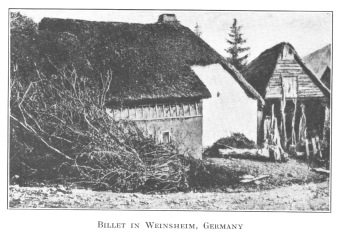 When Captain Dahmke, the regimental billeting officer, returned, he reported that the dispersion of the regiment could not be more complete. The highways connecting these towns were bad and none of the towns to which the regiment was moving were on railroads. The calamity seemed even more final when the troops reached their stations. These towns were simply aggregations of buildings grouped together along the highways. Many of the buildings had thatched roofs; not infrequently the men preferred the barns to the houses. But the men of the 353rd Infantry had learned to make the best of bad as well as good situations. What these villages lacked in com- fort their people made up in good will. They were of the large simple class that had borne the brunt of battle as well as war. Weinsheim with less than three hundred population had sent forty soldiers into the German army. Thirteen out of this forty would never return; some were still suffering from wounds; several others were held as prisoners of war. Experience had revealed to these people the vanity of their nation's program; now hatred and bitterness were submerged in grief. The crime of the imperialistic caste against these poor people seemed to the Americans even baser than that committed against the peoples of other nations. Not only the hardship of the inadequate shelter but the inconvenience to these people made both officers and enlisted men anxious for change of area. The movement to these towns had been made in a blinding snow storm and the weather grew steadily colder. When living conditions became all but intolerable, readjustment within the entire divisional area saved the day. On the 21st of December the 353rd Infantry was assigned to Prum, Niederprum and Romersheim. The scattered elements of the regiment were concentrated in this, their final area of occupation and the long march of two hundred forty kilometers, began on November 24th from Stenay, France, through Belgium and Luxemburg into Germany, was over. |

