|
The battle in the Argonne Forest was now on in all its fury. American divisions were being gathered from training areas and less active portions of the line for a part in this great final offensive of the war. Among those called was our neighbor on the left--the 42nd Division. Thus it fell to the lot of the 353rd Infantry to take over the St. Benoit Subsector on September 30th. 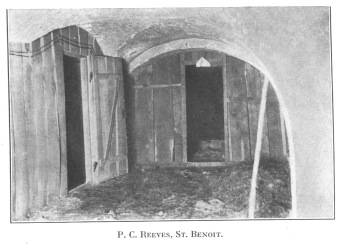 The outguard lines in this sector were now very thinly held. Companies "A" and "B" took over these positions in the new sector. The Third Battalion and the Regimental Machine Gun Company were in support in the vicinity of St. Benoit. The Second Battalion plus Companies "C" and "D" were in reserve in the Beney Woods. The advance Post of Command of the regiment was in the chateau in St. Benoit; rear echelon of Regimental Headquarters in La Marche; and the Supply Company in Nonsard Woods. While the intensest operation was on in the Argonne Forest, there was still enough activity in this sector to make life interesting. During the night of the relief, big shells lit in the Beney Woods. "H" Company's water wagon team was killed just as the driver was pulling into the reserve positions. However, troops on the outguard and in the support positions in the vicinity of St. Benoit suffered much from shelling. 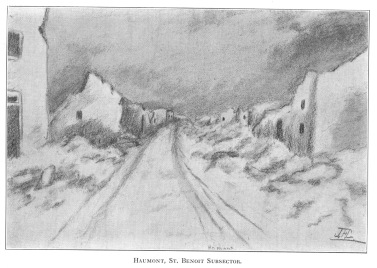 As had been the previous experience on this front, there was plenty to do in the development of the positions. Every night digging and wiring parties went to the front. The enemy had only recently been in possession of this territory, and knew every path and point of tactical advantage. While a working party was taking tools on the night of October 3rd from the captured supply dump in St. Benoit, German artillery bombarded with gas shells. "H" Company suffered ten casualties. When the blinded victims were led back through the sector on the following morning, there was a sort of mute determination in the faces of their comrades which forbode little mercy in future grips with the enemy, and the aggressive spirit of the regiment grew stronger than ever. Lieutenant Pine, with Sergeant Zimmerman, Corporal Shupe and a few others executed a most successful patrol into the town of Haumont whose ruins lay well toward the German side of "No Man's Land." Contact was gained with an enemy "chow" detail. Our men were experimenting for the first time with automatic shot guns. This fire-arm appealed immensely to the infantrymen, perhaps because of their familiarity with it in civilian life. Its first application on this occasion brought down two of the enemy; two others were glad to surrender as prisoners. The patrol returned in a very happy frame of mind. Their conversation and singing attracted the attention of Captain Dahmke who was in charge of the outguard line. His challenge brought back the answer, "A patrol." "What kind of a patrol is it?" he asked next in no uncertain terms. "A pretty good kind of a patrol," replied the leader, "we have two prisoners." With a warning to keep quiet, Captain Dahmke passed the patrol to the rear. But the contrast of activity in this sector to that of the one previously occupied made it appear like a "quiet sector." Moreover, a fine set of showers was located at La Marche, only a couple of kilometers away. Companies took turns for a general clean up. Plenty of clothing was available. Captain Keim had put the local laundry into operation. All that was required of the men was to shed their clothing, take their bath, and walk away with a new outfit. Rations were plentiful. In the reserve positions, the kitchens were located in the area occupied. It was a rest to be free from "chow" details. The weather, too, cleared up and conditions became quite satisfactory. There was a marked improvement in the morale of the men until orders called for the delivery of all enemy property in the hands of the men. Previous souvenirs must be turned in under pain of court martial. Careful inspections disclosed twelve leather belts, thirteen pair of field glasses with cases, twenty Lugers, two sabers, and quite a few other minor trinkets, valuable only in the associations of their acquirement. It was hard to part with these keepsakes. One buck prilosophized, "I nearly lost my life over this d---- Luger and I guess I can't afford to take any chances on disgrace by keeping it." So complete reports were rendered. Joys came along with the disappointments. On October 5th news reached us in the following form:
But so far as we were concerned, there were no orders to "CEASE FIRING." More plausible news came to camp on October 7th. A special Divisional Memorandum read:
On October 8th the 37th Division came from the Argonne drive to take over the sector. According to information from them, the war was by no means over. Surely the telegram transmitted through Sweden was not consistent with the facts on the ground. Whatever the future held, the 353rd Infantry had done its duty in the Pannes-Flirey-Limey sector. The regiment had been continually on the front, from right to left--Xammes, Beney, and St. Benoit in order. Each battalion had had its turn on the outguard line. The ranks were very much depleted but in every instance the regiment had acquitted itself as a first class fighting organization. |

