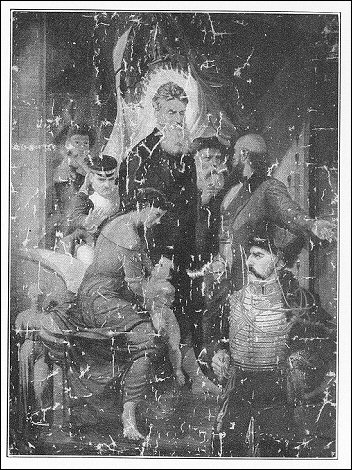
 A reproduction of Louis Ransom's painting (1860) owned by the Oberlin College. It will be noted from the photograph that the original painting is badly cracked. |

|
THREE pictures were published a year ago under this title and as a result attention has been called to others on the same theme, together with additional information pertinent to the series. Robert S. Fletcher has contributed an article, "Ransom's John Brown Painting," and a photograph of the picture in its present state, both of which are printed in this issue. Boyd B. Stutler of New York, who has one of the finest John Brown collections in the country, has been most generous in making available the contemporaneous newspaper articles cited below which are not accessible in Kansas libraries. He directed attention to the painting by T. S. Noble, and furnished a reproduction of the woodcut used in John Greenleaf Whittier's National Lyrics (1865). Members of the Kansas State Historical Society will recall his address before the annual meeting of the Society in 1932. [1] The Ransom painting was first exhibited at Utica, N. Y., in November, 1860. Mr. Stutler has found a contemporaneous notice of the event which contains the following description:
The reference to the "Continental" applied to the man in the left background of the picture. Mr. Stutler identifies this figure as a |
|
member of a military company, the "Winchester Continentals." The comment of the present writer a year ago was incorrect on this point, but the purpose of the painter was to make use of the Revolutionary hat with its '76 emblem and to emphasize thereby the incongruity of associating that insignia with service in the interests of slavery. The hat and the emblem are not made to appear so conspicuous in the painting as in the lithograph. In the photograph of the Ransom painting in its present state the reader will see that the banner of Virginia as a whole shows only indistinctly, that the first part of the motto "Sic Semper" is not distinguishable at all, but that the lower portion, within the encircling word "Tyrannis," forms a halo around Brown's head. In the Currier & Ives lithograph of 1863 the treatment is quite different; the flag is visible, with its motto and device, the whole serving as a background for his head, the portion within the word "Tyrannis" less conspicuously providing the halo. The newspaper description quoted above commented upon the whole banner, but emphasized the halo effect. The Harpers Weekly article of 1863, quoted in Fletcher's article, remarked upon the halo. The fact that Ransom revised the painting in later life raises the question whether the flag in its present state is essentially the same as it was originally or whether it may have been more nearly like the lithograph. A similar question is presented by the heads of the mother and child. Was the mother the classic Greek of the present painting or the negroid-Greek hybrid of the lithograph. Whether using the word advisedly or not, the newspaper writer of 1860 referred to them as "representative" of the negro race. No contemporaneous comment has been found which clearly determines the point, but Fletcher offers in his article the results of his inquiries. Other differences between the painting and the lithograph are evident to the observer, but these seem the most significant. In last year's introductory note the date of the Hovenden painting was given as 1881. This was on the authority of a personal letter cited in the footnote. The date has been challenged and on further investigation the Metropolitan Museum of Art, New York, amends the original statement, the date inscribed on the painting being 1854. The error in the museum's records occurred as the result of a misreading of the final figure "which was due to the manner in which the 4 is made." [3] |
|
In 1865 John Greenleaf Whittier published a collection of his poems under the title National Lyrics (Boston, Ticknor & Fields, 1865), illustrated with woodcuts by three artists, George G. White, H. Fenn and Charles A. Barry. One of the illustrations gave a version of the negro baby story to accompany the poem "Brown of Ossawatomie." It is not known which of the three artists produced the woodcut, but it affords an interesting variation of the tradition. Unlike the others, no attempt was made to idealize Brown, and it is the only picture of the series in which the observer looks down upon the scene rather than up at Brown. The painting by Thomas S. Noble (1835-1907), "John Brown's Blessing," is life size and is signed and dated, being completed and exhibited in 1567. A large folio lithograph of the painting was issued the same year. The painting was presented in 1939 by the children of the artist to the New York Historical Society through whose courtesy it is here reproduced. It was exhibited in Boston in December, 1867, and in New York in January, 1868. [4] The contemporaneous newspaper notice in The Commonwealth, Boston, Mass., December 14, 1867, is as follows:
|
A reproduction of Louis Ransom's painting (1860) owned by the Oberlin College. It will be noted from the photograph that the original painting is badly cracked. |
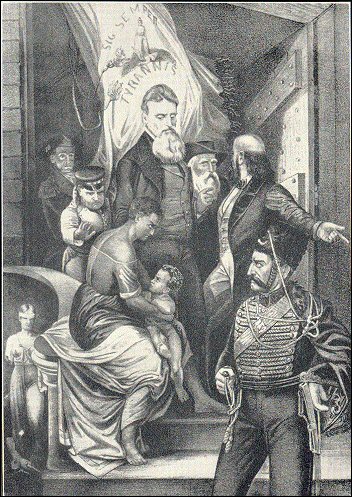 A reproduction of a Currier & Ives lithograph (1863) from the collections of the Library of Congress. |
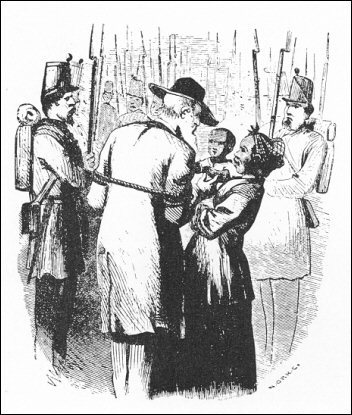 Unsigned woodcut in John Greenleaf Whittier's National Lyrics (First Edition, 1865). |
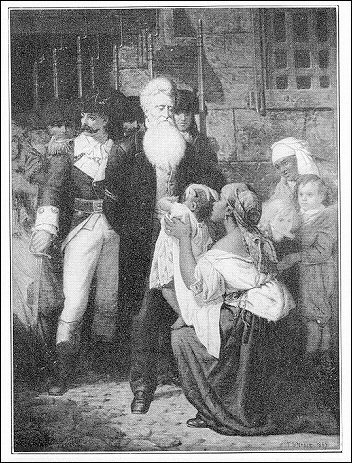 Thomas S. Noble's painting (1867) reproduced through the courtesy of the New York Historical Society, New York City. |
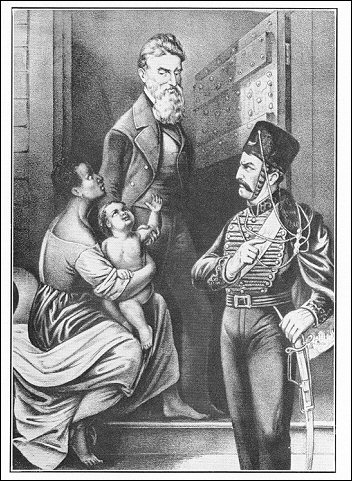 A reproduction of another Currier & Ives lithograph (1870) from the collections of the Library of Congress. |
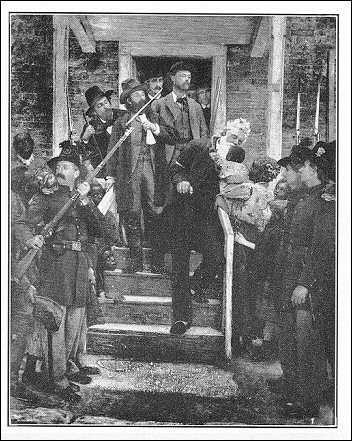 A reproduction of Thomas Hovenden's painting (1887) in the Metropoitan Museum of Art, New York City. |
|
In order to bring together all the pictures in one place for more convenient study and comparison the three printed last year are reprinted, the series of six being arranged in chronological order: Louis Ransom, "John Brown on His Way to Execution." Oil painting, 1860.
Oberlin College. 1. The Kansas Historical Quarterly, v. II, p. 80. |


